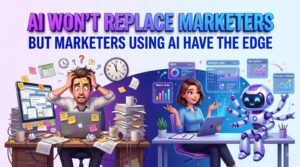

Imagine running a store. You have products that people love. Your website looks great. You have an advertising budget.
There’s a problem.
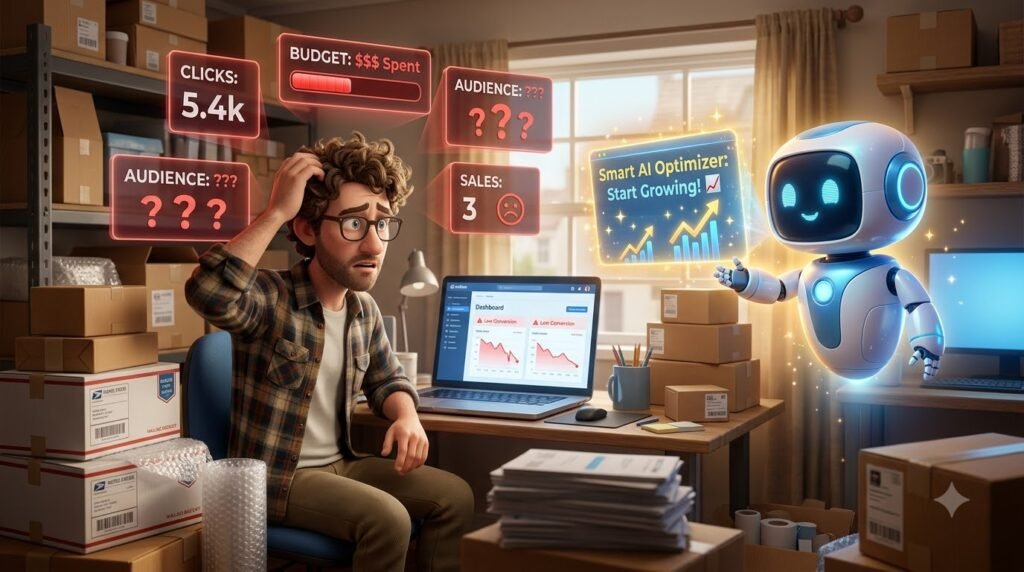
You spend hours picking audiences. You adjust bids. You test ads. Some ads get clicks but no sales. Others don’t get attention at all.
What if technology could take care of some of that work? What if you could focus on your business instead?
That’s where AI-powered ads come in. Tools, like Google’s Performance Max use intelligence to automate parts of advertising. This includes bidding, targeting and ad delivery. You give the system your goals, your budget and your creative materials. Then the system uses all of that to help find the customers.
However, AI cannot serve as a magic button to increase sales. It is all about automation and alignment with strategic objectives.
Let us figure out how it works.
What Are AI-Powered Ads?
AI-powered ads apply artificial intelligence to make decisions regarding advertising campaigns management.
Instead of a marketer making decisions about all settings manually, the process is automated on the basis of available data that allows for predicting decisions that could bring the best results.
For example, AI of Google makes decisions regarding:
- Who will be interested in your offer.
- Where your ads should be displayed.
- How much you should bid for an ad placement.
- Combinations of images, text, and videos that should be used.
- Decisions made in Performance Max are based on your campaign objective, creative assets, target audience data, and others.
Consider AI as an assistant that makes lots of decisions but still requires you to define success criteria.
Where Performance Marketing Fits In?
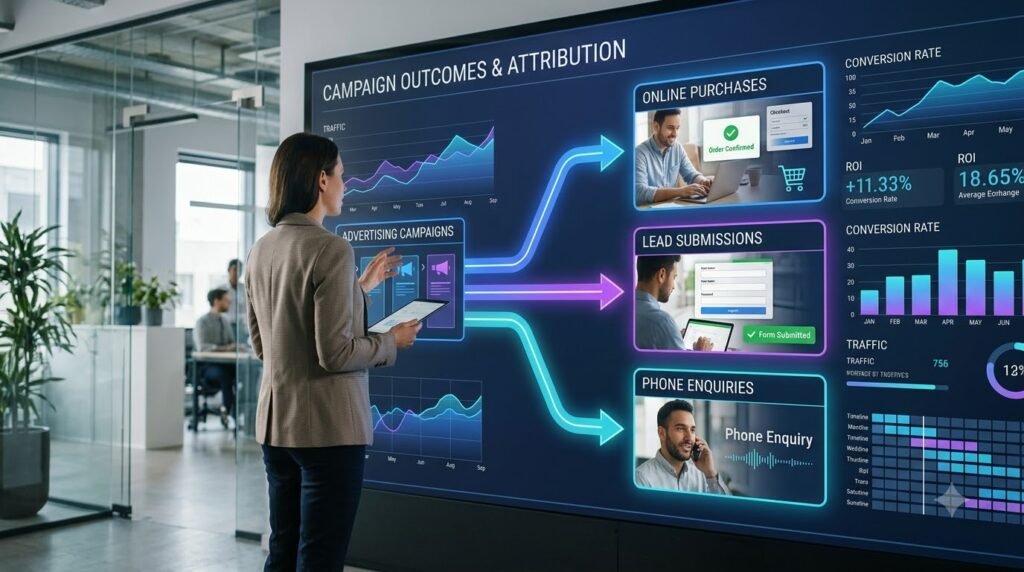
As for the blog, performance marketing is the kind of advertising that revolves around measurable outcomes.
The outcomes can be related to making a purchase, contacting the company, or making a reservation. In the Google Ads platform, advertisers are free to specify their conversion goals (the actions that need to be done by their customers) and utilize automated bidding to achieve those conversion goals.
This point is important.
If you require purchase conversions, your advertising system should know about the goal of making a purchase. If you need your customers to contact you, it should be aware of the actions considered a proper contact.
How Automation Is Changing Performance Marketing?
1. Bidding Happens in Real Time
A bid is how much you are ready to pay for an ad placement.
It is time-consuming to manually change bids. Google Smart Bidding employs artificial intelligence to change bids in each ad auction depending on the probability of a conversion or the value of this conversion.
Essentially, it attempts to provide the answer to the following question:
“Will this ad placement help us to achieve our goal?”
This means that automatic bidding is not the same as choosing one bid and sticking to it.
For instance, an online shop may choose a specific approach to getting more orders. Another online shop may want to get the maximum possible profit with their budget. Google provides Smart Bidding approaches to both goals.

2. Audience Targeting Becomes Less Manual
Selecting an appropriate audience may require guesswork.
Would you aim at only one age category, or only one set of interests, or users who have already been on your website?
AI-assisted audience targeting removes some guesswork out of the process. Performance Max helps in finding the clients based on your objectives and cues from the target audience using Google’s advertising networks.
What really matters here is the word “help.”
You will still have to know your client. An unclear offer won’t be valuable even if an algorithm presents it to more people.
3. Ads Can Reach People Across More Channels
The customer does not stay everywhere in the digital world.
Performance Max from Google is a tool for advertisers to launch one ad campaign in such channels as Search, YouTube, Display, Discover, Gmail, and Maps. The AI in the tool helps determine where to launch ads depending on campaign goals.
It transforms the role of the marketer.
The marketer does not have to make placement decisions manually but focuses on setting up the right goal, creating creative content, and assessing the effectiveness of the campaign.
4. Creative Testing Becomes More Automated
Have you ever created two headlines for an advertisement and wondered which one would be more liked by the people?
AI technologies can also help you with handling multiple options of your creativity. The Advantage+ products of Meta have an option of automation of creative combination, while Advantage+ creative can make modifications in ads in order to show different variations to different viewers.
However, your contribution is equally important. Be sure to provide good quality product pictures and statements and messages that reflect your company’s voice.
A Simple Case Study: A Local Clothing Store
Consider the example of a local clothing store in Karnal who wants to increase the number of orders on their website.
This is how one may proceed—with no guarantee of results:
- The owner picks up completed orders as the campaign objective.
- He/she establishes an advertising budget that he/she can handle.
- He/She supplies pictures, videos, and brief descriptions of his/her products.
- An automated campaign is utilized to facilitate the work with bids and ads.
- Orders and costs associated with advertising are analyzed; not clicks only.
- It is a classic Performance Max process where the advertiser provides the goals, budget, and creatives for the campaigns to be managed by Google AI.
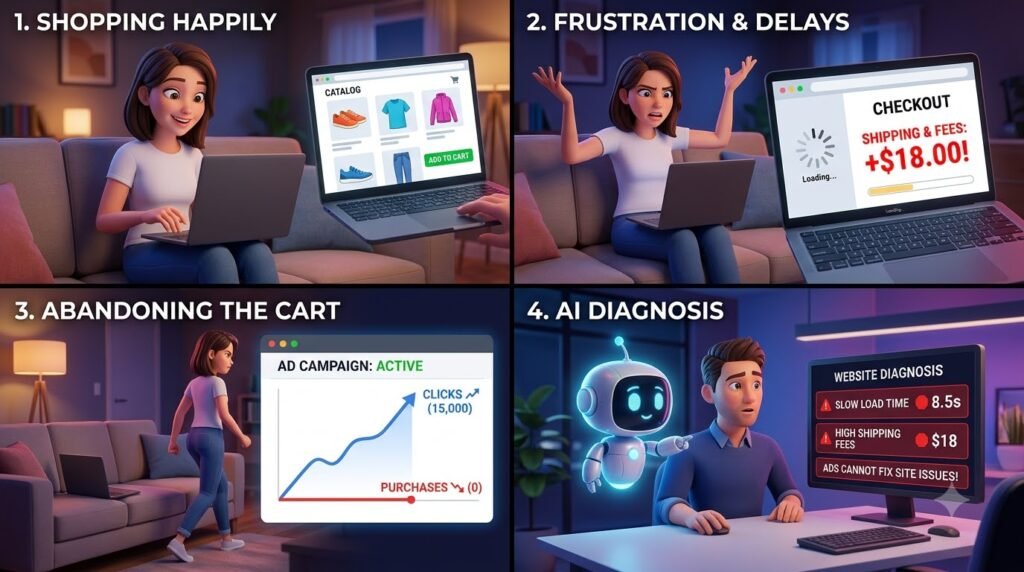
Now, consider that the loading time of the store’s website is bad or the delivery fees are not clear enough.
While the ad attracts attention, the user can drop off without placing an order. That is why an efficient advertising strategy should take into account not only the ad but also something else.

What Advantages Can AI Advertising Provide?
AI advertising systems are created for reducing manual processes and optimization of advertising campaigns to the selected goals by the advertiser. In Google advertising campaigns are automated via Performance Max, while Meta uses Advantage+ systems for automation of campaign and creative delivery processes.
From the perspective of a businessman, it may provide:
- Reduction of the number of settings to be configured manually.
- An increase in creative combination possibilities.
- Automated bidding according to the conversion goals.
- More time available for the offer and customer experience.
These are features to consider, not guarantees. An automated decision-making system cannot guarantee profits.
Does AI Replace Marketers?
These tools automate parts of the work; they do not remove the advertiser’s role. Performance Max still requires advertisers to supply goals, budgets, and creative material.
A useful way to divide the job is:

The strongest approach is not “humans versus AI.” It is humans giving automation a clear direction.
Conclusion
Ads using AI technology are transforming performance marketing through automation of tasks that had to be constantly managed manually. The examples of such technology include Smart Bidding, Performance Max, and Meta Advantage+.
It would be wise to set an objective first, offer good creative assets, and then measure success through metrics important for your business.
Leave it up to the AI to make the decisions, while you should maintain control over the strategy.