
Information discovery is changing. People are losing their wayfinding skills. In the past, search engines would return a list of websites based on a simple matching of keywords. Today, with artificial intelligence, search engines are becoming more conversational and appropriate for the modern way of asking for information. In 2026, artificial intelligence-enabled search assistants and generative models are changing how users discover information. Behind the shift is the move towards Generative Engine Optimization (GEO).
Generative Engine Optimization is a new approach to optimizing and creating digital content so that it can be discovered, understood, and referenced by generative search engines. Instead of ranking for keywords, GEO seeks to create structured, high-quality content so that an AI system can use the content to answer user queries.

What is Generative Engine Optimization (GEO)?
Generative Engine Optimization is a new and upcoming online marketing approach that is intended for AI-powered search engines. In conventional SEO, the goal of websites is to achieve higher rankings on search engine result pages. But for AI-powered search engines, the results usually include direct answers that are produced from a variety of sources.
GEO is centered on making content easily understandable by AI search engines. This includes the production of well-organized content, the use of straightforward headings, the provision of factual information, and the inclusion of credible references. When AI search engines scan online content, they usually favor credible and well-organized sources.

Key platforms in 2026:
– ChatGPT, including ChatGPT Search
– Google Gemini/AI Overviews/AI Mode
– Perplexity AI
– Claude
– Microsoft Copilot
– Multimodal tools
GEO differs from traditional SEO, which relies on search engine rankings and click-throughs in SERPs, in that GEO relies on citation, summarization, and authority in zero-click/direct answer scenarios. Less than 10% of cited sources in major generative AI tools (ChatGPT, Gemini, and Copilot) appear in Google’s Top 10 Organic Results for the same query, indicating that traditional SEO is no longer relevant to AI.
Why 2026 is the tipping point
The adoption rate of AI search has increased exponentially. Consumers will have preferences for their favorite AI search engines (similar to Google vs. Bing in the old days). GEO has become mainstream: there are agencies, conferences, tools (Evertune, AthenaHQ, Otterly AI, and so on), and budgets allocated for it. The search volume will drop by 25% by the end of 2026 as conversational AI takes over.
GEO Connections to Key Digital Marketing Modules
Google Ads (Search, Performance Max, AI Overviews, Demand Gen)
Google has recently incorporated AI Overviews into search results, where ads can be shown together with generative responses. GEO-optimized content will give you a better chance of your brand being quoted by AI, which will result in a lower CPC. In 2026, it is essential to create landing pages and structured content centered around answers that can be easily understood by AI algorithms.
Impact: Lower CPC and increased conversions due to AI-powered search sessions.
Meta Ads (Facebook, Instagram, Advantage+ Campaigns)
Meta platforms are becoming more dependent on AI for ad optimization and creative analysis. GEO will help increase your brand credibility off the platform, which will result in increased user trust when they see your ads on Facebook or Instagram.
Impact: Increased engagement and improved ROAS because users already know the brand.
Instagram & Facebook Organic / Social Media
Social media is turning into a discovery and search platform. GEO strategies such as providing clear insights, data-driven posts, and optimized profiles will help AI algorithms refer to social media content. Short-form videos and posts will also increase visibility.
Impact: Increased organic reach and improved traffic to marketing funnels.
Email Marketing
As zero-click searches increase, email becomes an important direct channel. GEO helps users discover your brand through AI answers, while email nurtures that interest with useful content and offers.
Impact: Better open rates and stronger customer relationships.
Other Channels (YouTube, TikTok, LinkedIn, etc.)
Video content is becoming important for AI search results. Optimizing videos with transcripts, captions, and structured descriptions improves the chances of being included in AI-generated answers.
Impact: Higher visibility across multiple platforms and improved brand authority.
Also for More Information read this: Top 11 AI Tools for School Students to Improve Studies. Get help with homework, essays, exams like JEE & NEET, and learn smarter with AI.
GEO vs. SEO: Key Differences in 2026
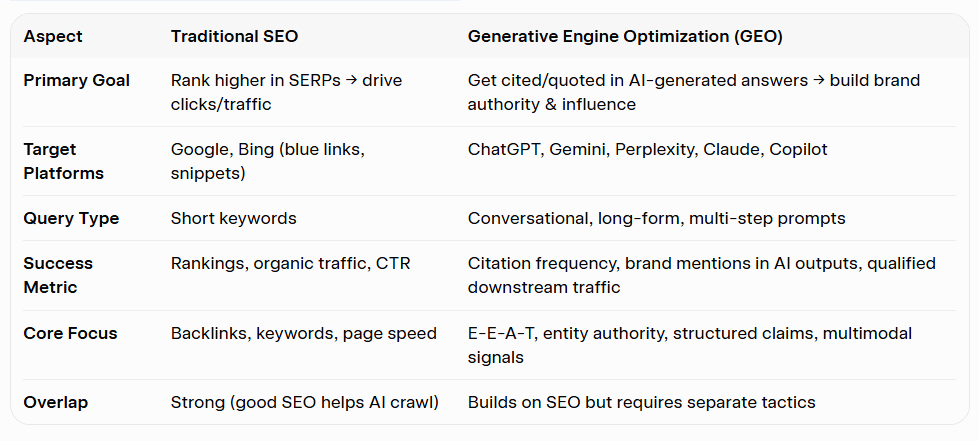
Top GEO Trends Shaping 2026
Semantic Context & Conceptual Depth Over Keywords
Move away from keyword stuffing and toward self-contained question-answer blocks with deep topic coverage.
Entity-Centric Optimization
Establish “entity authority” through schema markup such as same-as links and knowledge graphs, as well as consistent brand mentions across credible sources.
Multimodal Optimization
Text alone is not enough: add transcripts, alt text, image object/video object schema, and visuals for image/video-inclusive query types.
Earned Media & PR as Primary Lever
AI systems heavily favor journalistic/third-party sources, over 95 percent non-paid citations, and 27 percent of those are from news sources. PR now outperforms links for GEOs.
Claim-Based Content Architecture
Structure around verifiable, evidence-backed claims that AI can easily extract and attribute.
Hybrid SEO + GEO + Prompt-Level Optimization
Optimize for specific AI prompts; blur lines between traditional and generative tactics.
Paid Placements in AI Answers
Google expands ads in AI Overviews, Perplexity tests sponsored questions, and OpenAI explores monetization—blending organic GEO with paid visibility.
E-E-A-T Becomes Non-Negotiable
Experience, expertise, authoritativeness, and trustworthiness signals (author bios, original insights, and citations) dominate AI trust evaluation.
Importance of GEO for Digital Marketers
For digital marketers, GEO means an important change in online content strategy. With the advent of AI search technology, businesses must change their online content strategy accordingly.
Businesses that offer high-quality and organized content are more likely to be linked by AI search technology. It can help them improve their online presence.
Digital marketers should also focus on developing educational content, answering questions, and offering insights that can be easily processed by AI search technology.
Future of AI Search
In the future, AI search is going to continue to advance. Search engines are becoming more adept at understanding context, intent, and complex queries. With this in mind, the importance of GEO will continue to grow.
Content creators, educators, and businesses will have to focus on creating reliable and informative content. This will ensure their content is relevant in the age of AI search.
Conclusion
Generative Engine Optimization (GEO) represents a major change in digital marketing as more AI-based search engines enter the market. No longer can marketers focus solely on the optimization of keywords, as businesses must now provide structured, reliable, and informative content that an AI search engine can readily understand and reference.
As search engines such as ChatGPT, Google Gemini, and Copilot provide direct answers to consumers, marketers must change their approach to include high-quality content, authority, and information. In the near future, GEO will be an important tool for increasing online presence and remaining relevant in the changing AI landscape.
If you want to learn important AI tools and digital marketing, feel free to contact us at 9991267776. You can also visit the TechBooz Instagram page to get more information.
FAQs
1. What is Generative Engine Optimization (GEO)?
GEO is a strategy that optimizes content so AI search engines can understand, summarize, and cite it in their answers.
2. How is GEO different from traditional SEO?
SEO focuses on ranking in search results, while GEO focuses on getting cited in AI-generated answers.
3. Why is GEO important in 2026?
AI search tools like ChatGPT and Google Gemini are providing direct answers instead of website lists.
4. Which platforms use AI-powered search?
ChatGPT, Google Gemini, Perplexity AI, Claude, and Microsoft Copilot.
5. How can businesses optimize content for GEO?
By creating structured, clear, and informative content that answers user questions.
6. What type of content works best for GEO?
Educational content, guides, and question-answer formats.
7. Does GEO replace SEO?
No, GEO complements traditional SEO strategies.
8. How does GEO impact digital marketing?
It improves brand visibility in AI-generated search results.
Must Read:
- Best Digital Marketing Course in Karnal 2026: Fees, Duration, Syllabus, Online vs Offline, Placement & Student Guide
- Top 11 AI Tools for School Students to Improve Studies. Get help with homework, essays, exams like JEE & NEET, and learn smarter with AI.
- How AI Chatbots Are Turning Conversations Into Sales