
Prompt Engineering for Students in 2025: Unlock AI Secrets and Boost Your Skills
Hey friends! To be completely honest, have you ever asked ChatGPT or any other AI for assistance with a short story or history report? “Awesome!” is your reaction when you type in your question and the AI responds in two seconds.
Then you read it, though. The writing sounds completely robotic. It sounds just like every other paper in the class and contains large, uninteresting words. Your teacher can tell right away that it was created by a machine because it is so rigid and dull! Getting a C-grade response from the AI is really annoying. You wasted your time when you were hoping for a shortcut.
You know what? The AI is not to blame! IT’s all about the secret language you use to talk to it. Imagine the AI as an extremely intelligent puppy that will bring back a stick when you simply yell, “Go fetch!” But if you say “Fetch the bright red ball, and bring it to Dad in the kitchen,” It does exactly what you asked!

Prompt engineering is the secret skill you require. In essence, it involves learning how to be the AI’s best boss. You can get rid of those dull, pointless answers and start consistently receiving fantastic, straight-A grades if you can learn this one trick. Are you prepared to discover the code? Let’s get started!
Ready to learn the secret formula? Let’s turn you into a prompt powerhouse!
What is prompt engineering?
Prompt engineering is the art of designing and optimizing prompts to guide AI models, particularly LLM’s (Large Language Model), towards generating the desired responses. You can help the model understand your intent and provide a meaningful response by carefully crafting prompts that give it context, instructions, and examples. Consider it as giving the AI a road map that will guide it to the precise result you want.
It’s all about adding the right details!
AI is a student not a mind reader

First you need to understand that AI is a fantastic student, but it is not a mind reader with common sense.
It has access to everything ever written online. This is why it can produce something basic and dull when you give it a simple, vague task like, “Write about a shoe.” However, when you provide extremely specific, detailed instructions, like asking it to “Act as a famous shoe designer,” use a certain tone, and limit the words to “nature and speed,” you create a perfect assignment with a clear rubric. With good instructions, the AI can use its vast knowledge to follow the rules and create a highly creative and high-quality advertisement. You need to be an excellent teacher, or its work will be average.
The four essential ingredients of a perfect prompt engineer;
Every strong prompt includes four main parts. We’ll refer to these as the “Four Cs” since they all contribute to making your request Clear.
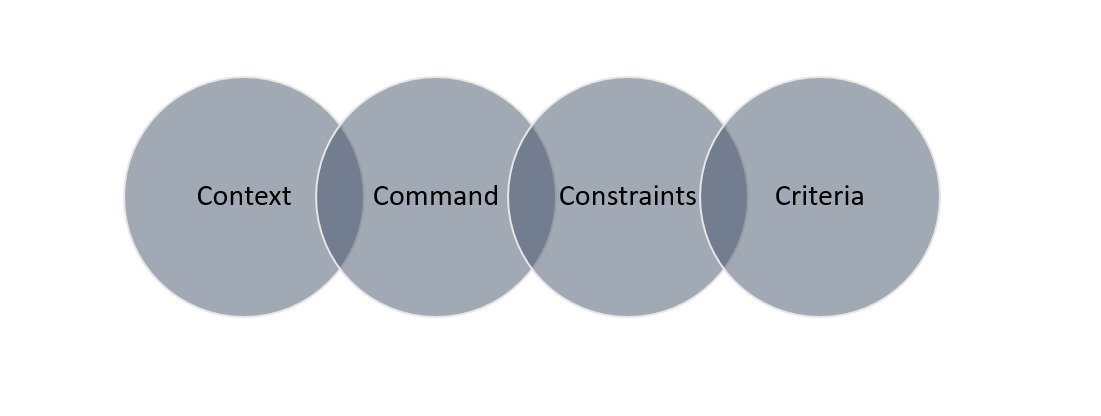
1. Context (give the AI a role):
The quickest and most effective way to improve your AI’s response is to assign it a role. This single trick changes the entire tone, style, and vocabulary of the output, making it much more specific and professional than a basic answer. To do this, simply start your prompt with a command like,
- “Act as a quirky, friendly travel blogger…”
- “You are a strict, smart high school history teacher…
” By giving the AI a job or a persona, you make it think inside a specific box. For example, a “movie director” will naturally talk about lighting and camera angles, while a “history teacher” will focus on historical facts and dates. This ensures your answer is targeted and high-quality.
2.Command (Define the task and the topic):

The central and most critical part of your prompt is the instruction that tells the AI precisely what to create, which requires you to be clear, specific, and highly detailed about both the subject and the final format. Instead of a vague request like “Write an article about phones” (which is too broad), you need to provide a specific action, such as, “Write a 500-word article for a tech website comparing the two newest phone models, focusing only on battery life and camera features.” This level of detail is important because you should specify constraints like the word count, the required structure (like “use three bullet points” or “write a three-paragraph summary”), and any necessary information the AI must include, ensuring the final output is targeted and minimizes your need for editing.
3.Constraints (set the tone and audience):
This important ingredient tells the AI how the finished products should sound, and just as importantly, who will read it. You define it by using descriptive words to set the tone and identify the audience. For example, you can choose the tone that is formal, funny, excited, or sarcastic and specify an audience like busy parents, high school students, or company CEOs. Setting the audience is the key.
- If your readers are high school students, the AI knows to use simple words and relatable examples.
- If the tone is sarcastic, the AI will include witty comments and jokes. Knowing the tone and audience changes everything about the final text.
This shows how crucial this step is for getting a perfectly tailored result.
4.Criteria (set rules and constraints)

The final step which is often overlooked, is too set clear boundaries for the AI. You should specify what it cannot do and what rules it must follow. You can achieve this with specific commands like,
- “Do NOT use the word ‘revolutionary’,”
- “Include a list of resources at the end,”
- “Write the entire answer in ALL CAPS.”
This step is an important editing tool. It helps you steer the AI away from repetition and clichés. For instance, if the AI keeps repeating the same tired phrases, you just tell it to stop. By adding these restrictions and formatting rules, you make the AI more original and ensure the final output is polished and free of errors before it even starts writing.
You have mastered the the four C’s, the essential foundation of great prompt writing. You know how to tell the AI who it is and it needs to do. However in the professional world, getting a good result once isn’t enough; we need perfection and consistency. Now we will explore the techniques used by professional engineers. These next three skills focus on maximizing your efficiency, giving the AI complex instructions without creating confusion, and learning how to communicate effectively to get the exact output you need.
Get ready to stop just typing prompts and start truly controlling your AI
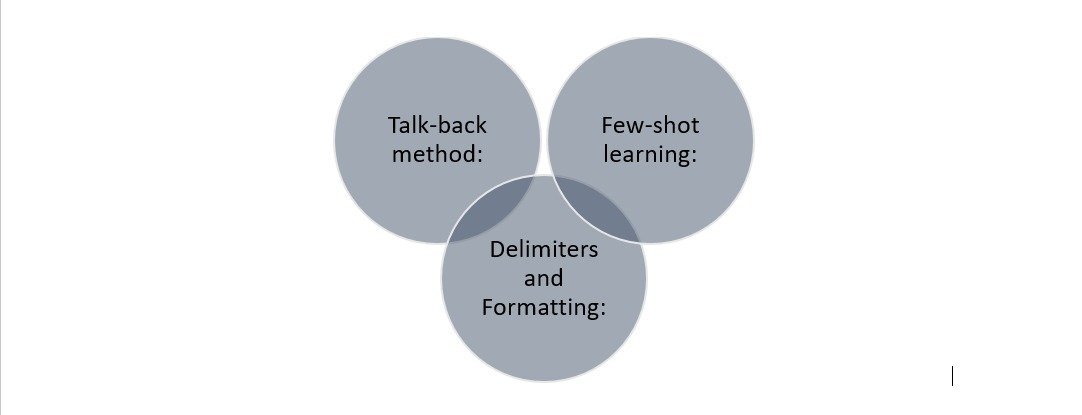
1.Talk back method:
A beginner sees a prompt as a one-time command, but a skilled Prompt Engineer understands it as a conversation. This method, known as iteration, involves giving the AI a brief starting prompt and then fine-tuning its response with a series of follow-up instructions, guiding it step by step. This approach works because the AI has a limited memory. Breaking a big task into small steps helps it stay focused and remember your rules throughout. For example:
- First Prompt: “Write a short blog post about the benefits of morning exercise.”
- Follow-up Prompt: “Now, rewrite that whole post to be highly motivational and specifically address people who dislike mornings.”
2.Few shot learning:

This is one of the most effective tricks because the AI learns best by mimicking you. The technique, called Few-Shot Learning, involves giving the AI one to three examples of the style you want before issuing the final command. The AI then uses these samples to quickly understand the tone, structure, and word choices you prefer. This level of detail goes beyond a simple command like “Tone: Funny.” For example:
- Example 1: “Dear Ma’am or Sir, I am writing to express my strong interest in the internship role posted on LinkedIn. I believe my skills match your requirements well.”
- Example 2: “Dear Professor, I regret to inform you that because of a family commitment, I will need to take leave on November 10th. I have attached all my completed assignments for the week.”
- Final Command: “Now, using this respectful tone, draft a brief email to the company’s HR department to check on the status of my recent job interview.”
3.Delimiters and Formatting:
The delimiters is a fancy word for a special marker that clearly separates your instructions from the specific text that AI needs to process, making the much less likely to ignore your core rules. By dividing up your prompt into distinct sections using special characters like angle brackets (<>), hashtags (###), or triple quotes (“”), you are effectively telling the AI, “Everything inside is the text you need to work on, and everything outside of these special symbols is the instruction.” As shown in this example:
- It is your responsibility to revise the student testimonial that is given below.
- Limitation: Reduce it to less than fifty words and eliminate any reference to “academy.”
- Testimony: “””Techbooz was essential to my professional development. The career support was truly outstanding, and the trainers were fantastic! I suggest the Techbooz to everyone.
Career advancement and Real world applications
While having a degree in a relevant computer science or engineering field is a plus, isn’t the only route. You can become a prompt engineer without a degree by completing certification courses, working on real-world projects, and continuous learning. Let’s delve deep to shape your career in prompt engineering.
1.Real world projects and portfolio building

With a clear understanding of AI technology and the skills mentioned, you can begin applying your expertise to real-world projects. Whether you are a working professional or a university student, seek out opportunities to volunteer for projects that require prompt engineering.
Here are some excellent AI projects you can start building:
- The Content Automation Kit: Build a complete content campaign, including an outline, blog, and social posts, from one idea using a single, efficient prompt sequence.
- The Style Replication Engine: Train the AI with the Few-Shot Technique to accurately match a specific brand’s voice for new content.
- The Constraint Challenge: Use Delimiters to make the AI revise existing text under multiple strict editing rules for precision and control.
If your project uses a pre-trained model, understand how it is built and how it behaves. Experiment with different ways to ask the model to perform tasks and observe its responses. Use the prompting techniques you’ve learned to activate the model. This approach will help you convert your theoretical knowledge into practical skills.
As you progress, consider participating in conversational AI and LLM-related competitions on platforms like Kaggle to assess your skills against your peers. Keep in mind that everything you accomplish at this stage can enhance your portfolio, strengthening your profile.
Having a professional portfolio is essential at any stage of your career. Datacamp offers an easy-to-use portfolio builder with attractive pre-made templates. Use this free tool to showcase your skills, experience, projects, and interests effectively.
2.Keep learning and engage with the AI community

To be a top Prompt Engineer, you should view the AI landscape as a classroom that is always changing. Your best approach is to be a consistent tester and active community member. Practice the Few-Shot Technique and Iterative Prompts by assigning AIs complex tasks with specific limits, then compare the results from different models like Gemini and ChatGPT. It’s important to connect with the AI community on platforms like Reddit and LinkedIn. Also, create a “Before & After” Prompt Library to demonstrate your ability to transform weak ideas into professional, high-quality results.
The key take away
The future of work belongs to people who can master this communication. Prompt Engineering isn’t just a trick for better homework; it is a real-world skill that improves your portfolio, helps you get jobs, and allows you to truly control the most powerful technology in the world.
Stop asking the AI for a simple stick, and start instructing it to build a masterpiece! Go practice your prompts today and turn your ideas into top results.
Prompt engineering isn’t just a skill for better AI homework—it’s a real-world superpower. By learning how to craft clear instructions, set constraints, provide examples, and iterate effectively, students can unlock the full potential of AI tools. With guidance from instructors, hands-on practice, and real-world projects, anyone can become a confident AI user, create high-quality outputs, and build a strong portfolio.
Conclusion

At Techbooz Karnal, students get the perfect environment to master prompt engineering and digital skills under expert guidance. With experienced instructors, practical projects, and interactive classroom sessions, Techbooz makes learning AI and digital marketing easy, fun, and effective.
So don’t wait join Techbooz today and start your journey to master AI, create amazing projects, and build a bright future!