

Think about yourself buying a new pair of shoes. You come across a product video on Instagram and decide that you like its design. Instead of going to the store and browsing their site, you just click on a link to WhatsApp. After that, you inquire about the price and size, getting responses from the seller. Having made sure about all the details, you buy what you need. It all started with a simple chat. This is the concept of WhatsApp commerce in India. Brands use WhatsApp to communicate with customers, show them their products, respond to their inquiries and facilitate the selling process. This may be more convenient for customers, and it offers businesses another way of contacting and engaging potential clients. But why is WhatsApp increasingly becoming an essential tool for online shopping? And what can brands do to improve their performance through WhatsApp?
Let’s find out.
What Is WhatsApp Commerce and Why Is It Growing in India?
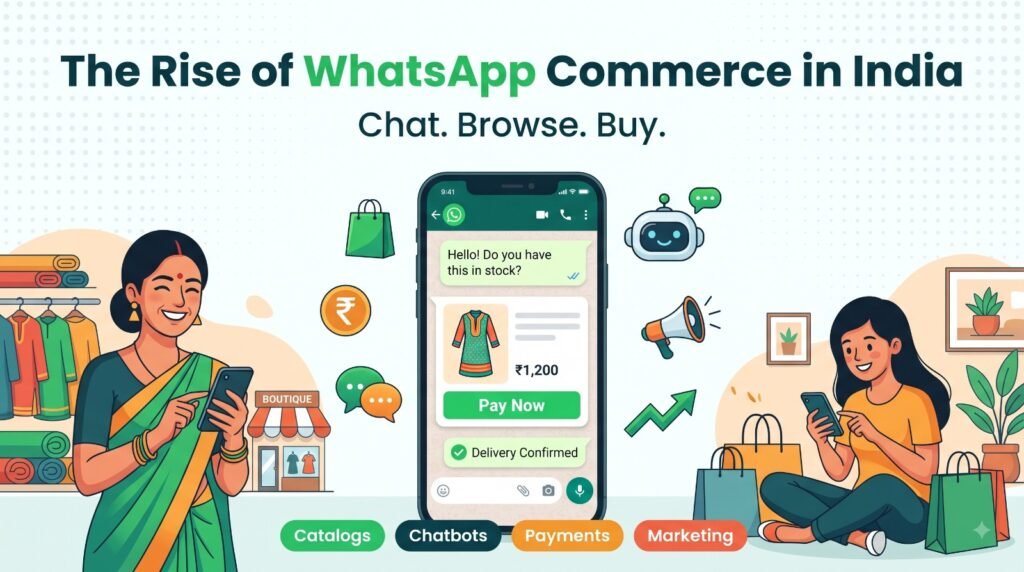
The term refers to using WhatsApp as a platform through which customers can make product inquiries and purchases. It enables business enterprises to reach out to their customers via chats, not only through the websites and shopping apps. Convenience is one of the factors that makes this form of commerce quite popular. It enables customers to inquire about a certain product, know its price and receive assistance without flipping through different pages. For instance, a consumer who wants a skincare product can send a message to a beauty store asking for recommendations. The store can provide information about the product and assist the consumer on the right procedures.
WhatsApp commerce can be adopted by a variety of business enterprises, such as:
- Clothing and footwear local stores
- Home-based business stores offering products such as cakes, gifts, or handmade items
- Skincare and beauty stores
- Restaurants offering takeout food
- Service providers attending to customer inquiries
- This kind of shopping can be referred to as conversational commerce.

How WhatsApp Business Helps Companies Sell Products and Services
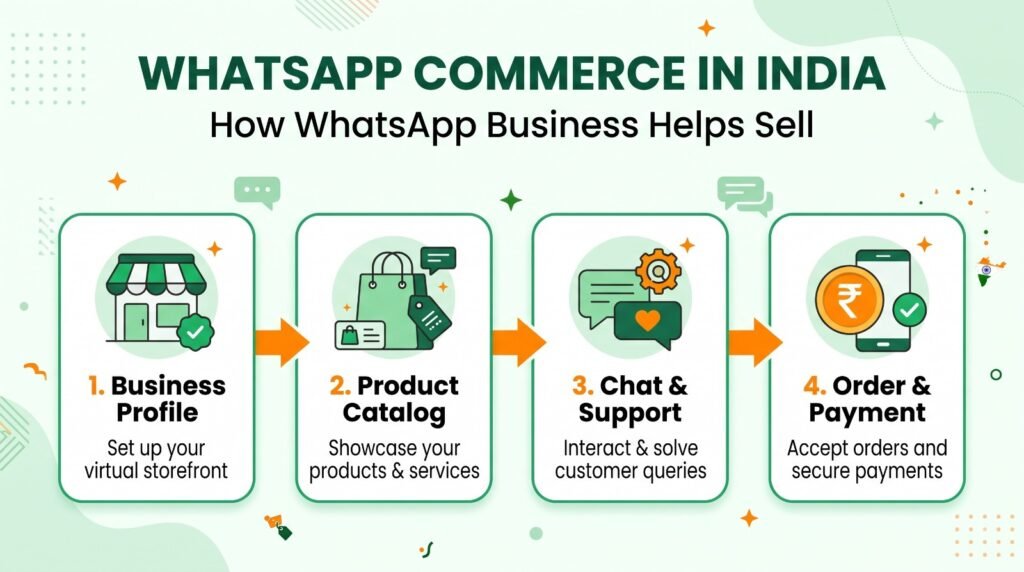
WhatsApp Business gives small businesses useful tools to manage customer conversations. Instead of using a personal account for every business activity, sellers can create a business profile and share important information. Depending on the account features, businesses may take advantage of the following instruments:
- Business profile: Provide the business name, description, address, and working hours.
- Product catalog: Show available products including their pictures, prices, and descriptions.
- Quick replies: Save the answer to common questions.
- Greeting messages: Greet customers upon initiating a conversation.
- Labels: Organize chats into certain categories such as new inquiry, order processing, completed order.
For instance, let us consider the case of a clothing store in Karnal that receives messages from clients concerning available goods, prices, sizes, and delivery options. In order to help the client to choose, it would be appropriate to present the product catalog. To provide the fast and convenient assistance, one should use the quick reply function. The store could guide the client through the ordering process as well as provide information on payment or delivery depending on the situation.
WhatsApp Marketing Strategies That Help Businesses Reach Customers
Simply sending messages to a large number of people is not a good marketing strategy. Customers are more likely to value messages that are useful, relevant, and sent with their permission.
Below are some ways through which companies can use WhatsApp marketing techniques:
Sending useful and relevant updates
Companies can send useful and relevant information like announcements about the products, special offers, tips, services and many other things to clients requesting for them.
For instance, if a salon has introduced a new service, it can notify those clients who are interested in beauty treatments. In addition, a clothing store can notify clients about new collections if they have shown interest in their products.
Using clear product information
The messages must contain enough information regarding the items offered. This can include price, size, stock, shipping fees and offer terms when appropriate.
The above information can save time since clients won’t ask the same questions again.
Linking Meta Ads with WhatsApp
Businesses can use eligible Meta advertising options on Facebook or Instagram to encourage people to start a WhatsApp conversation. These ads can help interested people ask questions directly. It is possible to encourage those who may be interested to ask additional questions via WhatsApp. For instance, an online store may advertise its products using Instagram ads. When a potential customer clicks the WhatsApp button, he or she will be able to ask some questions concerning the product prior to purchasing it. It may be helpful if customers need more information before buying something. However, it is still necessary to track conversion rates.
Sending too many messages is undesirable
Repeated promotions may disturb customers. Businesses should be aware of their preferences and should abide by the regulations of WhatsApp. It is important to give customers an option to unsubscribe from marketing campaigns.
Trust is key.
The Role of AI, Chatbots, and Automation in WhatsApp Commerce
As a business grows, answering every message manually can become difficult. Artificial intelligence (AI), chatbots, and automation can help manage some routine tasks.
For instance, a business could use automation to:
- Greet the new customer with a message.
- Inform about working hours and other basic information.
- Give answers on delivery or order questions.
- Provide the guidance to product information.
- Organize customers’ inquiries.
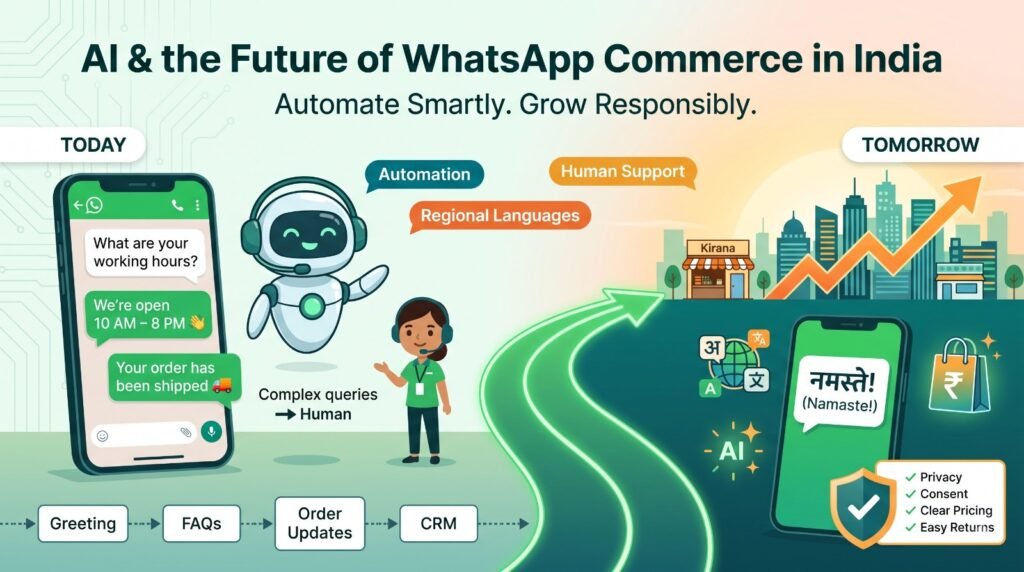
The chatbot is a technology that gives answers to customers depending on its configuration. There are bots that work with predetermined rules and those driven by artificial intelligence. Consider an online gift shop getting a lot of messages overnight. Automation could let a customer know its working hours and inform him or her about how to explore the catalog. A worker could give more details later, if he or she is free. There are limitations for automation. Incorrect information on price, availability, delivery or returns could harm the trust in your company. You have to control the automated answers and give the possibility to communicate with a live person to your customers. AI should simplify the customer support but not to make it impersonal.
Future of WhatsApp Business in India
The WhatsApp commerce provides business possibilities for those who wish to simplify customer interaction. With further development of digital shopping, the company might use automation more efficiently, provide personalization, and even communicate in the regional language. In turn, small business owners can use WhatsApp business for instant response and engagement. Customers can receive assistance before purchasing something, and sellers can know what questions are asked the most.
Yet, business should face some challenges too.
Privacy of customers: Personal information should be treated securely and used solely for the sake of the service.
Consent of customers: The business should have a necessary consent for sending commercial messages according to the platform rules.
Transparency and trust: Prices, delivery cost, payment options, and return policy should be disclosed to customers.
Human assistance: There should be a possibility for the customer to speak with a person in case the automated response cannot solve his/her problem.
Results tracking: Useful metrics are qualified inquiries, successful orders, recurring purchases, and customer satisfaction.

Conclusion
WhatsApp commerce in India is a great example of how e-shopping is becoming increasingly conversational. People have an option to query and explore different products using an application that they are already using. There are many tools to manage such conversations for businesses using WhatsApp Business tools, appropriate marketing messages, Meta Ads, and automation tools. Nevertheless, success is not measured by the number of sent messages but the ability to know your customers, share accurate information, protect privacy, and provide quality services. For those who study digital marketing, it is important to understand the concept of WhatsApp commerce. This way of doing business brings together content creation, paid advertisements, customer service, AI tools, and sales tracking into one process. Shopping in the future will not be limited to what a business will offer but also how conveniently it can make the customer’s choice.