
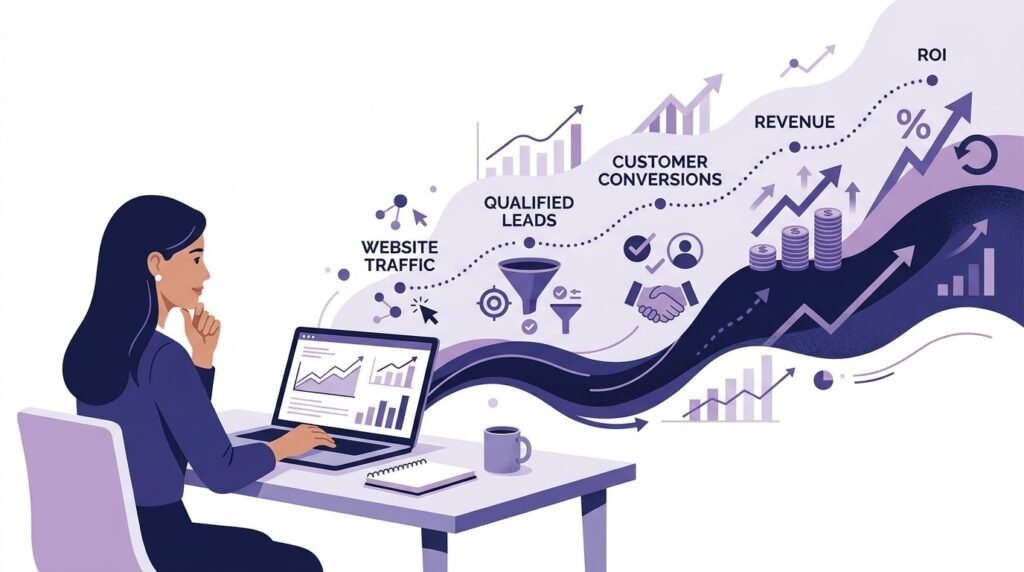
Businesses spend money on digital marketing to reach customers, generate leads, and increase sales. But spending money on ads does not always lead to good results. A business may receive thousands of website visits but very few enquiries. Another business may receive fewer visitors but generate more paying customers. The difference often comes from how well each business plans, tracks, and improves its marketing campaigns. Thus, performance marketing gains great importance. Performance marketing is the field that concentrates on measurable results such as website visits, leads, sales, application downloads, or enquiries. In 2026, the following technologies will be utilized for successful marketing: SEO, Meta Ads, analytics, and AI. But which activities actually improve return on investment (ROI)?
Let’s explore the strategies that help businesses get more value from their digital marketing budget.

What is Performance Marketing?
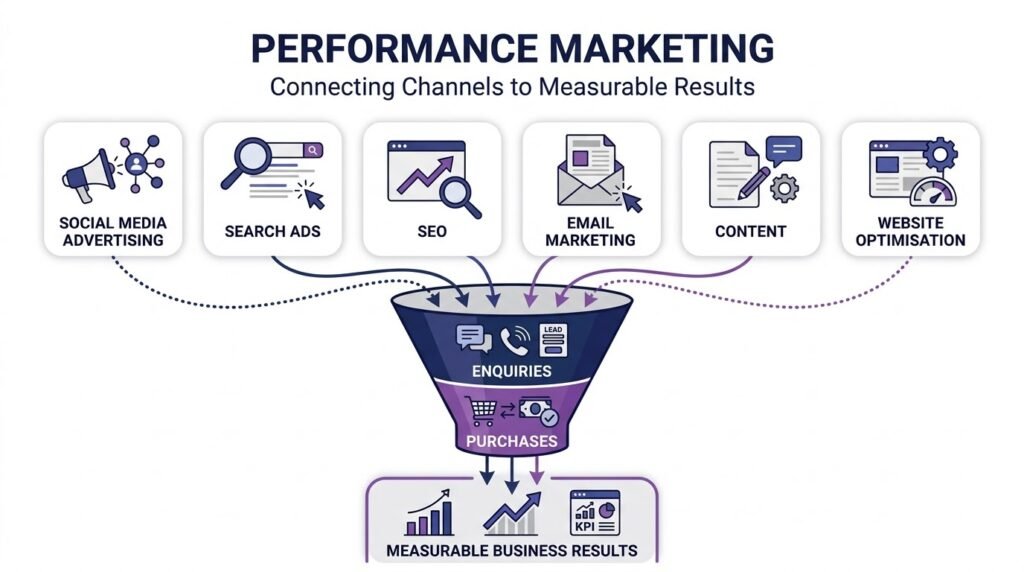
Performance marketing is a kind of digital marketing where campaigns are designed and measured according to particular goals. For example, a business may run a Meta Ads campaign to generate WhatsApp enquiries. Another business may use Google Ads to attract people searching for its services. An online store may focus on increasing product sales. Each campaign has a clear objective and measurable results. Popular performance marketing channels are:
- Meta Ads – advertising on Facebook and Instagram for lead generation, product sales, and brand awareness.
- Google Ads – paid search and other types of advertising aimed at helping companies find their customers.
- SEO – Improving website visibility in unpaid search results.
- Email marketing – communicating with potential clients through emails.
- Content marketing – creating blogs, videos, and social media posts that provide some value.
- Conversion optimization – improving websites and landing pages for better conversions.
The key point here is not about saving the money spent. It is about investing money wisely and getting valuable business outcomes.
1.Focus on the Right Metrics, Not Just Clicks
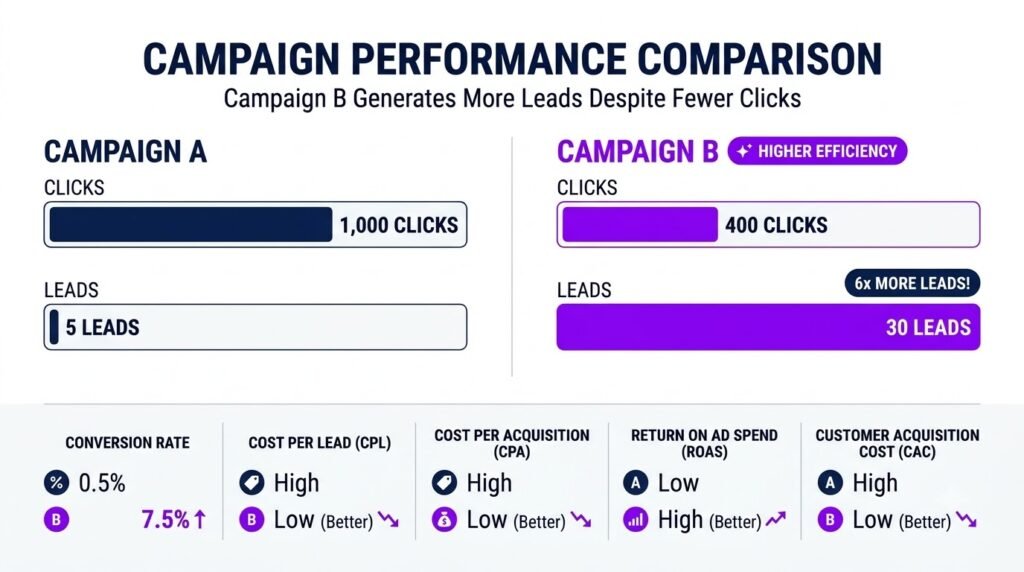
One common mistake in digital marketing is judging campaign success by likes, views, or clicks alone. These numbers can show interest, but they do not always show business growth. For instance, let us compare two marketing campaigns for the same digital marketing course.
Campaign A has 1,000 clicks, and generates five leads. Campaign B has 400 clicks, but generates 30 leads.
Campaign B is potentially more valuable than campaign A since it brings a larger number of interested potential customers at a lower cost.
When measuring performance of a digital marketing campaign, businesses must use metrics that correspond to their business goals.
Performance marketing metrics include:
- CPL (cost per lead): Cost of generating one lead.
- CPA (cost per acquisition): Cost of acquiring one customer.
- Conversion rate: Percentage of people taking a particular action.
- ROAS (return on ad spend): Revenue generated from ads divided by ad spend.
- CAC (customer acquisition cost): Total cost of marketing and sales required to acquire a customer.
For instance, if a business pays ₹10,000 on ads and generates ₹40,000 in revenue, ROAS equals 4x.
However, a 4x ROAS does not automatically mean the business made a profit. Product costs, salaries, delivery charges, and other expenses must also be considered. Measure business outcomes, not just marketing activity.
2.Use SEO for High-Intent Traffic
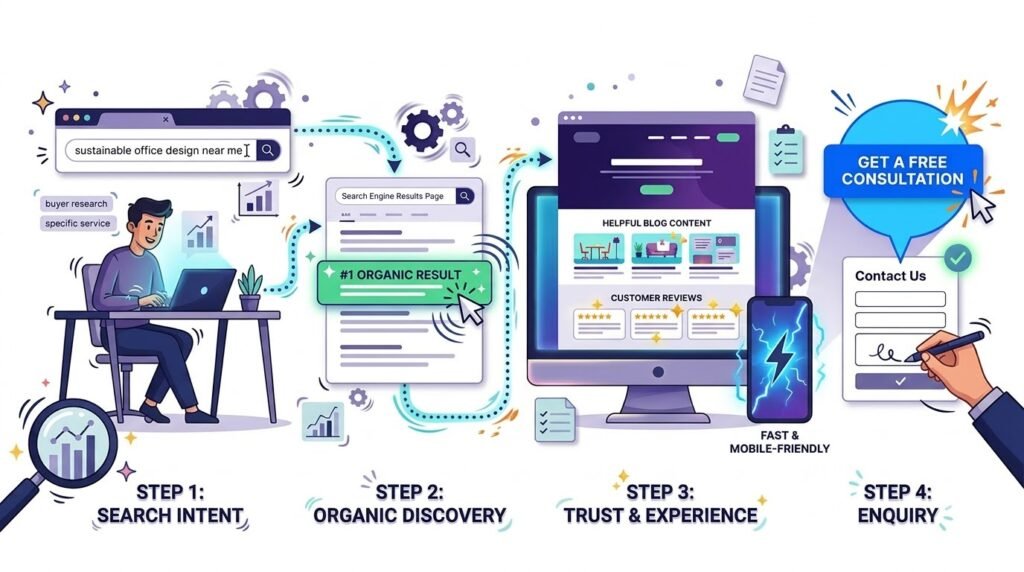
Search engine optimization is a method that will make your website visible on Google when searching for goods, services, or any other kind of information. SEO is a form of digital marketing that can bring steady traffic without paying for each click. SEO is particularly helpful when it attracts people that are ready to buy something. The person who searches for “best digital marketing agency in Pune” is much closer to buying something than the one searching for “what is digital marketing.”
For using SEO for better ROI you should:
- Create service pages for important keywords
- Write blogs answering customers’ questions
- Optimize your website for speed and mobile usability
- Add FAQs, reviews, and CTA buttons
- Create landing pages for special offers
SEO works great for paid ads too. If your landing pages are informative and understandable then the users will be able to act.
3.Enhance Meta Ads with Better Creatives and Offers
Meta Ads help businesses reach audiences on Facebook and Instagram. They can support awareness, lead generation, website sales, and WhatsApp enquiries. But simply launching a campaign is not enough. The creative idea, message, offer, target audience, and landing page will affect performance.
Here are practical ways to improve Meta Ads:
- Create a strong opening. Videos should explain the problem or benefit within the first few seconds.
- Test different creatives. Try different hooks, images, videos, and messages. Compare their results instead of assuming one version will work best.
- Match the offer to the audience. A student looking for job skills may respond to practical training details, while a business owner may care more about generating leads.
- Use a clear call to action. Tell people what to do next, such as sending a WhatsApp message, booking a consultation, or viewing a product.
- Check lead quality. A campaign that generates many enquiries may still perform poorly if most leads are irrelevant or cannot afford the service.
Creative testing should be planned carefully. Change and compare meaningful variations so you can understand what is improving results.
 4.Use AI Tools to Work Smarter
AI is becoming increasingly relevant in modern digital marketing. It can be used by teams to save time, get inspiration, and analyse data. However, AI does not guarantee better ROI. The results depend on how marketers use it.
Here are some practical uses of AI tools:
- Content creation: Generate blog outlines, ad copy ideas, and social media caption drafts.
- SEO research: Organise keyword ideas and create content briefs.
- Ad creative testing: Develop different headline and message variations for testing.
- Data analysis: Summarise campaign reports and identify possible performance changes.
- Customer support: Answer common questions through suitable chatbots and automated replies.
- Personalisation: Help organise messages for different customer groups.
For example, a marketer can use AI to draft five versions of an Instagram ad. The marketer can then review each version, make sure the claims are accurate, and test the strongest options. AI should support human decision-making, not replace it. Marketers still need to understand customers, check facts, protect customer data, and judge whether the content is useful.

5.Fix Conversion Problems Before Increasing Ad Spend
More traffic does not always mean more sales. Sometimes, the real problem is the website or landing page. Visitors may be interested in an offer but leave because the page is confusing, slow, or difficult to use. Before increasing the advertising budget, review the customer journey.
Ask these questions:
- Does the page clearly explain the product or service?
- Is the price or offer easy to understand?
- Does the page load properly on mobile devices?
- Is the contact form simple to complete?
- Can visitors easily find the WhatsApp or call button?
- Does the page build trust with useful information and genuine reviews?
Suppose 1,000 people visit a landing page and 20 submit an enquiry form. The conversion rate is 2%. If improvements help 30 people submit the form from the same number of visitors, the conversion rate becomes 3%. That is a 50% increase in conversions, assuming the traffic volume remains the same. This example shows why conversion rate optimisation can be just as important as generating more traffic.
6.Track Every Important Customer Action
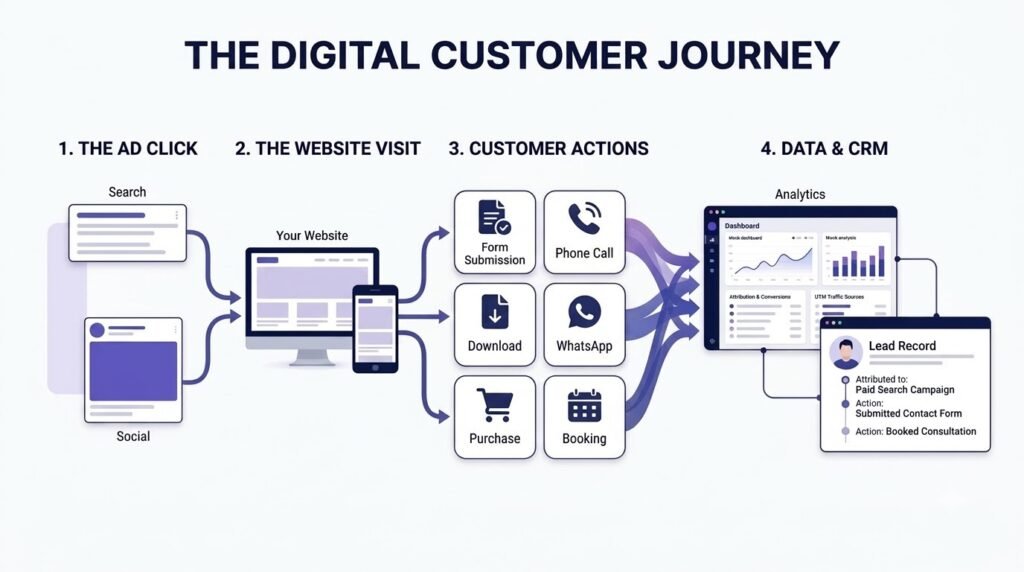
Good performance marketing depends on reliable data. Without proper tracking, a business may not know which campaign generates enquiries or sales. Tools such as Google Analytics 4, Google Tag Manager, Meta Pixel, and Meta Conversions API can help businesses measure customer actions when configured correctly.
Track useful events such as:
- Contact form submissions.
- WhatsApp button clicks.
- Phone number clicks.
- Product purchases.
- Brochure downloads.
- Consultation bookings.
Use UTM parameters to identify the source, medium, and campaign associated with website visits. Where possible, connect website leads to CRM records and actual sales. For example, if a business runs three different video ads, tracking can help compare the website visits and enquiries associated with each ad. Remember that tracking systems may miss some activity or assign credit differently. Use consistent reporting methods and check data quality before making major budget decisions.
7.Improve ROI with regular Testing
Performance marketing involves consistent testing and optimization.
- Define your objective of a particular campaign.
- Examine your existing performance.
- Find out what needs to be done better.
- Test various ad or landing page variations.
- Examine performance and take into account successful approaches.
If your ad brings you many clicks, yet lacks enquires, consider analyzing your audience, offering, and landing page before increasing your budget.
Conclusion
The key aspect of performance marketing in 2026 lies in making smart decisions, rather than spending more money. SEO drives organic traffic, Meta Ads help to reach your prospective clients, and AI is used for content creation and analysis. Conversion tracking will provide businesses with valuable insights.
At TechBooz, we believe practical digital marketing skills help learners turn data into better decisions.
Remember: Better ROI comes from better strategy, testing, and measurement.