

Do you want AI tools such as ChatGPT, Perplexity AI, and Google AI Overviews to cite your blog? Many people want that for the same reasons as you, and those include getting high-intent traffic and creating credibility instantly.
When compared to search engines, AI provides a direct answer without giving the user several links. In addition, the answers are provided based on information trusted by AI. This puts your blog in a position of reliability for thousands, or even millions, of users who may rely on that information.

However, the truth is that:
AI doesn’t pick random information; instead, it goes after well-structured and authoritative sources.
The good news? You don’t need a huge website or thousands of backlinks to get started. With the right approach, even smaller blogs can get featured.
Here are 10 simple, proven strategies that actually work to help your content get noticed—and cited—by AI.
Write Original, Unique Content
AI-powered platforms such as ChatGPT and Perplexity AI are built to avoid selecting repetitive and generic content. Blogging about the same thing that is already doing well on Google will likely go unnoticed by the algorithm.
Instead, AI favours content that provides unique value to the discussion by providing either:
- Personal experience or perspectives
- New frameworks or strategies
- Case studies or outcomes achieved
- Research or new examples
In other words, AI is searching for the most relevant and unique response.
Rather than stating:
“SEO plays an important role for ranking webpages” (a statement that everyone can find),
You might as well say:
“The usage of optimized FAQ schema in our promotion for a regional business helped boost AI citations by 32% in 45 days.”
Tip: Ask yourself, “Can someone find this exact info on 100 other sites?” If yes, rewrite it with your own voice.

Use Specific Statistics and Data
AI technologies such as Google AI Overviews and Perplexity AI are programmed to focus on factual data. This is why content based on numbers and measurable data is always preferred by these platforms.
When we say something generic like “many people enjoy shopping online,” it doesn’t mean anything. However, if we say “67% of users enjoy online shopping because it is convenient,” then our content is immediately considered factual and useful not only for users but also for the AI algorithms.
Why does data help AI?
- It makes your content more reliable
- It offers some specific quotes that can be easily extracted by AI
How to enhance your content using data?
- Include new statistics related to the latest year or trend
- Use percentages and other measurable data
- Provide results of your campaign or projects
For example:
Instead of saying “content improved traffic”, say “After restructuring content with FAQs and schema, organic traffic increased by 38% in 60 days.”
That level of detail signals authority and makes your content more “AI-friendly.”

Add Expert Quotes and Citations
One of the things that AI systems like ChatGPT and Google AI Overviews are quite serious about is credibility and trustworthiness. The simplest way to achieve both is to include quotes and authoritative links in your text.
The more you mention professionals and experts in the field—doctors, scientists, or industry leaders—the more likely it is for your blog post to be viewed as a source of reliable and researched information rather than an expression of opinion. Therefore, the odds of AI trusting your content grow dramatically.
For instance:
while you might be tempted to write something like this:
“Content marketing works,”
You should aim for something like this instead:
“According to marketing specialists, companies that use content marketing have 3x more leads than their peers.”
Incorporating authoritative information into your texts increases the chances of your content becoming a trusted source.
To get there, you can:
- Include expert quotes
- Refer to scientific studies and researches
- Mention reputable institutions or publications
Not only will this improve your standing in front of AI but also make you more reliable in the eyes of your readership.

Use Tables to Make Information Easy for AI to Read
AI systems like ChatGPT and Perplexity AI are made to find important information in a straightforward way. And tables are one of the simplest formats for them to understand.
When we look at tables we can see that they are a lot easier to read than paragraphs. Tables show us the information in an organized way, which makes it simple for AI systems like ChatGPT and Perplexity AI to find the main points and use them to answer questions. This is why people are more likely to reference content that has tables comparing things.
Tables are really useful when you want to compare the features of tools or services. You can use tables to show the differences in pricing. Tables are also helpful when you want to break down the bad points of something. You can use tables to highlight the differences between before and after results.
For example, tables can be used to:
- Compare features of tools or services
- Show pricing differences
- Break down pros and cons
- Highlight before vs, after results
For example:
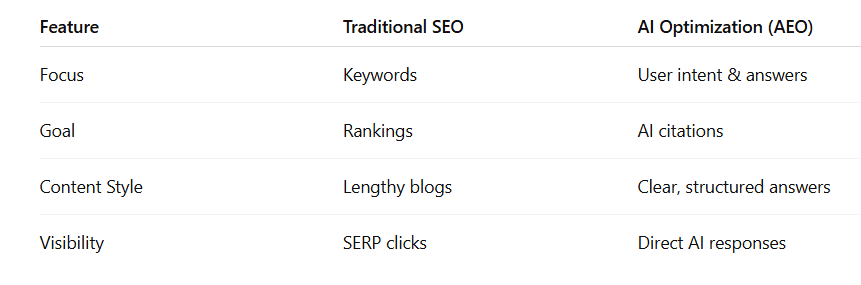
This type of format is really helpful because it lets artificial intelligence find comparisons away.
One important thing to remember:
You should always use HTML tables, not pictures.
Artificial intelligence has a time reading words that are, inside pictures so using the correct table format makes sure that people can see everything you are trying to say.
Write in Plain, Conversational Language
Artificial Intelligence understands English better than complicated words. If a 10-year-old can understand your sentence Artificial Intelligence will too.
How to make things simple:
- Use sentences that are about 10 to 15 words long.
- Do not use words, like “utilize” or “methodology” or “paradigm”.
- Write like you are talking to a friend.
- Use “you”. I” when you talk, instead of using formal language.
This works because Artificial Intelligence is trained on the language people use every day on the internet. When you write like a person Artificial Intelligence understands what you are saying faster and it uses your content more often.
For example:
- Do not say “utilize this methodology for results”.
- Say “use this method for the results” instead.

6. Use Question-and-Answer Format
People ask AI questions. If your content is written as questions and answers AI is sixty percent more likely to cite you.
How to Structure Q&A:
- Ask a question people actually search for.
- Answer it directly in one to three sentences.
- Then explain more if needed.
Common Question Formats
- What is…?
- How do I…?
- Why does…?
- Which is better…?
Why It Works:
When someone asks Perplexity “How do I optimize for AI search?” AI finds your Q&A section. Pulls your answer directly.
Example
Q: What is GEO?
A: GEO or Generative Engine Optimization is writing content so AI tools like ChatGPT cite your website when answering questions, about GEO.

7. Make Headings Actionable and Clear
Headings are really important because they help computers like AI figure out what your writing is about. When you use headings that tell people what they will learn it is very helpful.
Some good examples of headings are:
- “How to Add Expert Quotes in 3 Simple Steps”
- “5 Tools That Increased My Traffic by 45%”
- “What Is GEO and How to Start in 2026”
On the hand these headings are not very good:
- “Quotes”
- “Tools”
- “GEO”
The reason this works is that computers look at headings to decide if what you wrote is a good match for what someone is asking. When your headings are clear the computer can understand it faster which means you have a chance of being cited.
One thing you can do to make your headings is to include important words like “how to” or “best” or “step-by-step” or the year “2026”, in your headings.

8. Include Real-World Examples
AI ignores ideas but it loves real examples that actually happened. Posts with examples are more trusted by the AI system.
What is a real example?
- A real example is something like your results for instance you can say “I was able to increase traffic by 45 percent”
- A clients case study is also an example.
- A brands success story is another example.
You can also use before and after screenshots. Make sure to include the timeframe and numbers.
The reason this works is that anyone can say something like “this works”. When you show specific results with actual dates and numbers the AI system trusts you more.
For example saying “content marketing helps businesses grow” is not very convincing.
On the hand saying “my blog got 2,300 visitors in April 2026 after I published 5 search engine optimization posts, which is up from 400 visitors in March” is a much better example.
The AI system likes examples like this one because it has actual numbers and dates. The AI system trusts content marketing examples like this one, then vague ideas.

9. Optimize Your Images with Alt Text
AI can “read” the alt text you write for images. Images with detailed alt text are 40% more likely to be referenced by AI.
What is alt text?
It’s the short description you add to an image so screen readers and AI know what the image shows.
Bad alt text:
- “chart”
- “image”
- “screenshot”
Good alt text:
“Bar chart showing 67% of ChatGPT citations come from original research (2025)”
“Before/after photo: Instagram followers grew from 500 to 3,200 in 3 months”
Why it works:
When AI searches for image-related answers, it uses alt text to find the right image and links back to your article.

10. Keep Your Content Fresh and Build Authority
People like to read things that’re new and come from people they trust. If something is old or never changes people will not look at it.
Here are some ways to keep things fresh:
- Add when it was last updated, like ” updated: May 2026″ at the top
- Change old numbers to new ones like from 2023 to 2024 to 2026
- Add new things, like examples or tools
- Fix things that are broken like links
There are some ways to show people you are good at what you do:
- Tell people who you are with a picture and what you are good at
- Show people where you have been like on news sites or podcasts
- Get good websites to link to you
- Share what you write on places like LinkedIn, Instagram and Facebook
This works because companies that are always online and update things are more likely to be talked about. The internet sees you as someone who knows what they are talking about not someone who writes things.
For example:
If you do not have a picture or any information about yourself and you have not updated things since 2022
It is better to have a picture and say who you are, like “I’m Aditi Bansal I help people, with digital marketing and I have been featured in XYZ Blog” and to say when you last updated things like “Updated: May 2026”.

Conclusion
Getting cited by AI tools like ChatGPT and Perplexity isn’t luck—it’s about writing content that AI can trust and understand. When you follow these 10 strategies (original content, real data, expert quotes, tables, simple language, Q&A format, clear headings, real examples, image alt text, and fresh updates), you make it easy for AI to pick your blog.
What happens when AI cites you?
- Your blog appears in AI answers
- Real readers click through to your site
- Your brand becomes more trusted
- You get free traffic without ads
Start small. Pick 2–3 strategies for your next post. You’ll see AI begin to mention your content within weeks. Write smart, useful content, and AI will share it for you.
If you really want to rank higher in Google search results, then must read this: